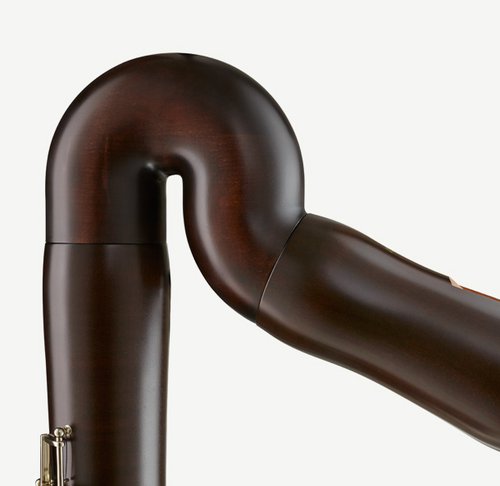
Even today, there is no equivalent substitute for wood as a natural material in the manufacture of high-quality recorders. Not only does it look elegant, but it also has many properties that make it the material of choice for the manufacture of recorders that meet the highest standards.
These include it being easy to shape, its ability to absorb moisture and its outstanding sound characteristics. These qualities make wood clearly superior to other materials. It is also sustainable and available in many different types, whose varying properties naturally also influence the sound.
Nevertheless, most recorders worldwide are made of plastic. The main reason for this is the hardness of the plastic, which is much less sensitive than wood, and the low cost of production. However, ‘large manufacturing tolerances’ are permitted in the manufacturing process, especially for inexpensive plastic recorders. As a result, these instruments are poorly tuned, do not respond well at high pitches and sound unsatisfactory.
Yet, there are also plastic recorders that are manufactured using more complicated processes, which require a professional recorder maker. This is reflected in a significantly higher price, however.
The sound of a recorder is influenced not only by its construction, but also by the different properties of the materials used. The pore and fibre structure, density and hardness of the wood used are all important factors. Wood hardness in particular is a good indicator of certain sound characteristics.
As a rule of thumb, the softer the wood, the more suitable an instrument for making music in groups or in an ensemble. Harder and denser woods, such as palisander or grenadilla, produce a clear and radiant tone. Instruments made from these woods are therefore ideal for solo playing. Medium-hard woods are particularly suitable for instruments that are used as all-rounders in both ensemble and solo playing.
Of course, this rule of thumb is somewhat simplified, because the design of the recorder is the most important factor in determining its suitability.
Nevertheless, we have developed a hardness scale that offers assistance chosing a suitable model and allows to compare it with other models in our range. The scale ranges from 1 (soft wood) to 5 (hard wood) and is defined for each model in our range of recorders.
Further information can be found in the PDF below this article.
For some beginner recorder players, the German fingering system seems easier at first glance: if you close all the tone holes and then remove one finger after another, starting from the bottom, you can already play the basic scale. However, if you go beyond the basic key in the pieces you are playing and have to play certain semitones, you will find that some notes are slightly out of tune. This is where the German fingering system reaches its limits.
So if you want to play more than just simple folk songs and don't want to limit your repertoire from the outset, it's best to start with the Baroque fingering right away. It may seem more complicated at first, because you have to use an alternative fingering even for the basic scale (for the tone F), but it allows you to play all semitones across two octaves with accuracy. With baroque fingering, there is nothing to stop you from learning sonatas or concertos.
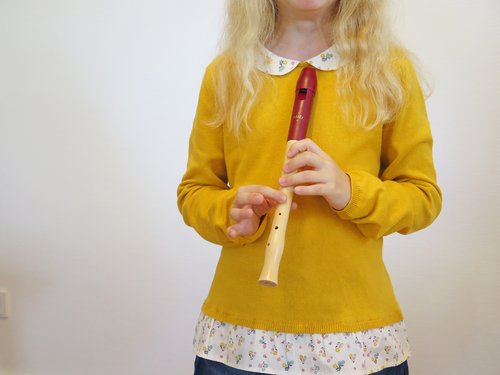
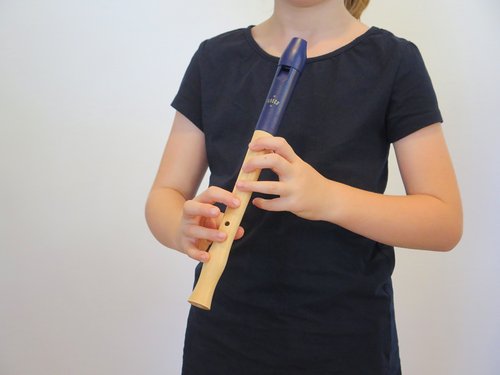
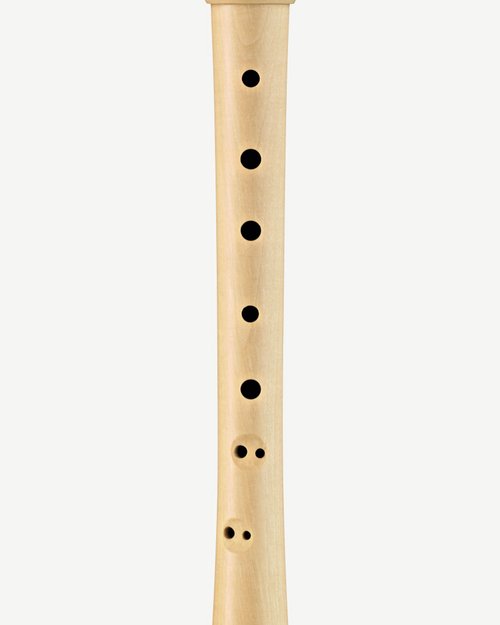
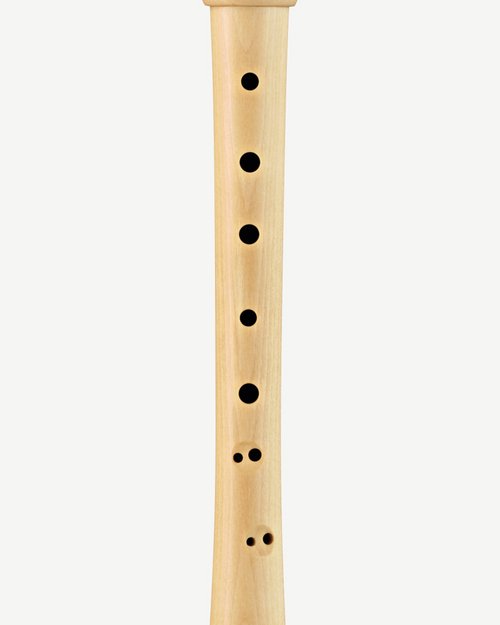
How can I recognise the fingering of a recorder?It is easy to find out which fingering is required on a recorder by simply taking a closer look at the holes:If the fourth tone hole is large and the fifth is small, as shown in the picture on the right, then it is the German fingering. With the Baroque fingering, it is the other way round: the fourth tone hole is smaller than the fifth.
How can I recognise the fingering of a recorder??
It is easy to find out which fingering is required on a recorder by simply taking a closer look at the holes:
If the fourth tone hole is large and the fifth is small, as shown in the picture on the right, then it is the German fingering. With the Baroque fingering, it is the other way round: the fourth tone hole is smaller than the fifth.
There are no reliable fingerings for the next higher semitones for the lowest notes on the recorder. It does not matter which fingering the instrument has. The presence of double holes instead of single holes is helpful here, because they allow the original tone hole to be opened or closed ‘proportionally’ to the right extent, so to speak. With double holes and baroque fingering, all chromatic notes can be played in tune.
To play lower c on the soprano recorder, all the holes have to be covered. For the low C sharp, open the smaller of the lower double holes and you will reliably get the right note. The same applies to the interval D/D sharp. The same also applies to recorders of other pitches: on the alto recorder, this applies to F/F sharp and G/G sharp, on the tenor recorder to C/C sharp and D/D sharp, etc.
For the lower pitched instruments from tenor recorders downwards, the function of the double holes is replaced by double keys.
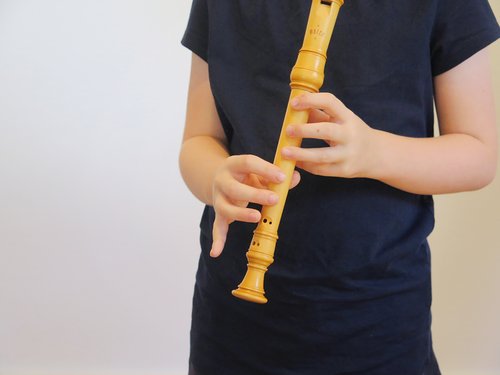
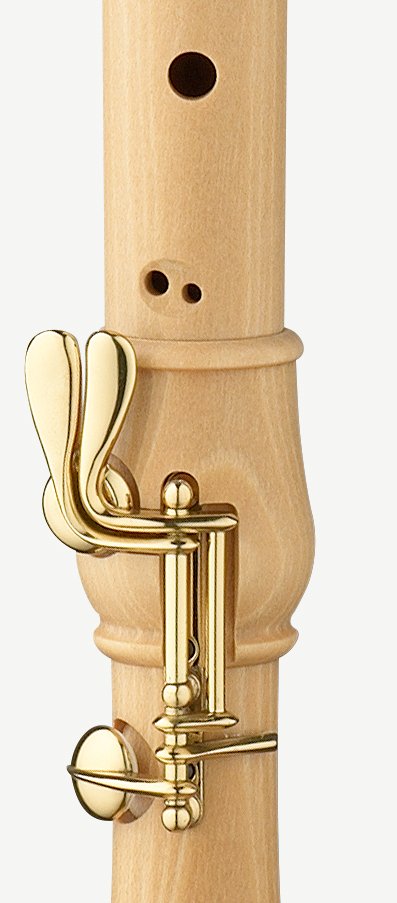
Many everyday items are now available for left-handed people, but do left-handed recorder players also need special recorders? We don't think so, because when playing the recorder both hands have similarly complex tasks to perform. The recorder is therefore more of an instrument for ‘ambidextrous’ players. Left-handed recorders are therefore very rare.
If you still decide to buy a left-handed recorder, you will have to accept certain disadvantages:
- the choice of instruments is relatively small.
- There is no significant second-hand market.
- In an ensemble, you will not be able to respond to different instrumentation requirements unless you have enough instruments yourself.
Taking these disadvantages into account is an individual decision, but for the reasons mentioned above, we see no need for recorders designed specifically for left-handers.
Moeck recorders are tuned to a pitch of A1 = 442 Hz. The reason for this is the pitch of pianos, which nowadays is usually between 443 Hz and 445 Hz. When properly warmed up, our recorders also reach this pitch, while remaining compatible with older recorder models (and other instruments), which are often tuned to 440 Hz. Slight differences of 2 Hz in pitch can be compensated for by gently pulling apart the tenon connections without noticeably affecting the intonation. Excessive pulling apart, on the other hand, affects the accuracy of the intervals and would therefore ruin the intonation.
Since the standard pitch has been steadily raised over the course of time, not only for pianos but also in modern professional orchestras, we consider the pitch of A1 = 442 Hz to be a good compromise to the standard pitch of A1 = 440 Hz, which has actually been in use since 1939 and still is today in amateur music-making and in churches.
When tuning a recorder ensemble, the instrument with the lowest pitch is used as a reference. When playing together with other instruments, a tuning fork or tuner can be helpful. However, there are limitations when tuning the recorder: tuning it to a hgher pitch requires warming it up to body temperature and blowing with strong pressure. Lowering the pitch, at least up to approx. 2 Hz, can be achieved by slightly pulling out the recorder parts. But be careful: pulling them out too far will impair the tuning and response.
a1 = 415 Hertz
Many players prefer instruments in so-called low pitch for a more “authentic” performance of Baroque music. Although there is no known standard pitch for Baroque music, the various common pitches were below the standard concert pitch of A1 ≈ 440 Hz used today. Recorders in ‘low pitch’ of A1 = 415 Hz are a semitone below their ‘high’ counterparts.
Moeck offers the following Baroque recorders at low pitch i.e. a1 = 415 Hz:
- Steenbergen Soprano
- Denner Alto
- Stanesby Alto
- Hotteterre Tenor
- Rottenburgh Bass
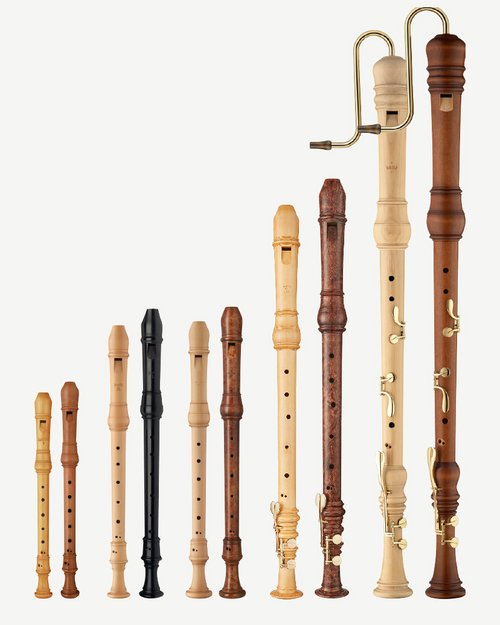
Recorders with long diapason have always existed and many models with long diapason were made at the beginning of 20th century at the time of the rediscovery of recorders. In practical terms, making recorders with the so called short diapason has prevailed. Instruments made in this way have a full and brilliant sound in the upper register but in the lower register the sound is relatively delicate. A further advantage is that the tone holes for the right hand are spaced closer together which makes for easier fingering. Perhaps that is the reason why these instruments are more popular.
The properties of the sound of the recorders with long diapason is is a warm basic tone, the lower register has remarkable strength and stability. A high f# (flutes pitched in f) can also be played without covering the bore at the bottom. Keys are essential on these instruments as the finger holes for the right hand are spaced wider apart.
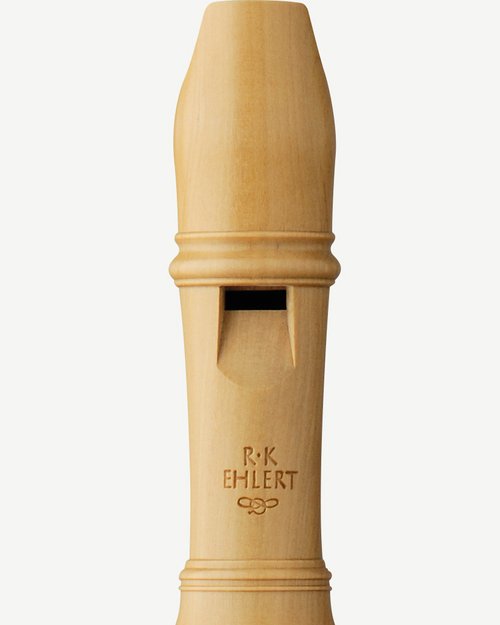
A special variation of the recorders with long diapason is the modern instrument, developed by Ralf Ehlert for Moeck. He drew together the wisdom from previous eras of recorder making into one instrument which distinguishes itself with an exceptional strength of sound and dynamics without losing the characteristic sound of a recorder.
The Ehlert recorders are ideal for recorder literature from all eras and corresponding styles. With their assertive strength of sound, they can hold their own when playing with strings, brass and wind instruments and keyboard instruments.
Moeck offers the following recorders with a long Diapason:
- Ehlert recorders
- Hotteterre Tenor
- Rottenburgh Bass
- Rondo Bass & Great Bass
- Subbass
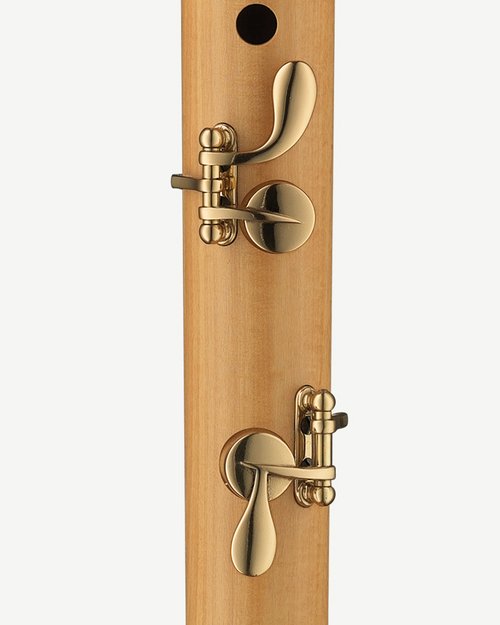
Not everyone who wants to play the recorder can manage the required fingering. Some player's hands are too small to cover all the tone holes, while others, especially older people, have problems with finger mobility or other ailments that make playing the recorder unnecessarily complicated or even impossible. In these cases, keys can work wonders.
It is usually the tenors that are difficult to handle. The lowest notes in particular are difficult to reach with the little finger of the right hand. That is why our range includes models that come with double keys for C and C sharp as standard. The PLUS version also has additional G or F keys, which reduce the spread required to play for both hands to a comfortable level. Larger recorders, such as bass or great bass recorders, always have key systems, so the problem of difficult fingering does not arise in the first place.
However, if you find it difficult to cover individual tone holes while playing, individual solutions can often be found – regardless of the pitch of the instrument. If you are interested in individual keys adapted to your personal needs, please feel free to contact us.
Recorders with a bent neck can be a suitable alternative if the basic playing position causes problems . Larger instruments in particular present players with ergonomic challenges. Tension can occur in parts of the body far away from the fingers and still have a detrimental effect on their mobility.
In such cases, an instrument with a curved design may be the solution. The curve between the head and the middle joint means that the distance from the shoulder joints to the correct hand position on the instrument is slightly shorter, so the arms are less stretched. Often, the relief on the wrists leads to freer movement of the hands, and covering the tone holes suddenly becomes easy and effortless.
Our instruments with a bent neck are available in pitches ranging from tenor to great bass. Our subbass has a bow instead of a bend, as it would be unplayable with a bend due to ist size.
Whether with a bend or bow, from bass to subbass, both constructions also have acoustic advantages, as the instruments can be played directly and are therefore more variable and offer manifold options for articulation. A bocal is not necessary and its associated delay is avoided.